The biggest dinosaur is the Brontosaurus. They 3D print the bones of dinosaurs. They printed the bones of the dodo bird and then put real feathers in. When they 3D print the bones, they have to rub it with alcohol because it is sticky at first. —Sammy Barsalou
I learned that they don’t use AI. I learned that the biggest dinosaur they made was a Dodo bird and that was interesting because I like Dodo birds and it was just cool. There is nothing else I found interesting! —Aveline Krayeske-Bermudez
Collin Morét works on a lot of stuff like anthropology and the 3D printing of animals. People paint the 3D printed animals. I asked, what was the coolest thing he printed, and he said, “The coolest thing I have printed was I printed a Titan beetle for my friend.” His friend found a Titan beetle and he wanted to show his other colleagues the print, and he wanted it to be slightly bigger than the real beetle. Collin Morét also showed us the 3D prints he had made like the Dodo bird, the Scorpion, dinosaur bones and the North Pacific Octopus.—Emmanuel Plascencia
The Dodo bird was made of real feathers and 3D printing—Agnes Guajala
The facts that I learned were interesting. I learned a lot about the models and how they did the models. Collin Morét also showed how they hand paint the models and also how they use taxidermy animals. It was exciting how we learned about the extinct animals.—Jason Lin
Technology at Yale is getting smarter so it is getting easy to replicate animals that are dead and alive with 3D printing. I also learned that the fossils are very popular. It was cool to learn everything. — Van Smith.
I learned that they are upgrading the 3D printer at The Peabody Museum. They worked with anthropology. The stuff Collin Morét said was really cool. I learned so much. He also works with vertebrate paleontology. The Dodo bird was one of his favorite projects. One exhibit was anoles. The current project is the octopus and they are finishing glueing stuff onto it and looks so good. The models were for students to learn. —Dima Ali
My impression of Collin Morét’s presentation is that is job is very impressive and interesting. I liked how he described how he 3D prints his animals instead of using taxidermy. 3D printing is an amazing replacement of taxidermy, which is taking an animal’s insides out and stuffing them. Collin Morét has taken 3D printing and used it as an alternative and I think that’s great. I also noticed an octopus that he 3D printed, which looks like a sculpture. I admire how he made 3D printing look human made.—Autumn Dixon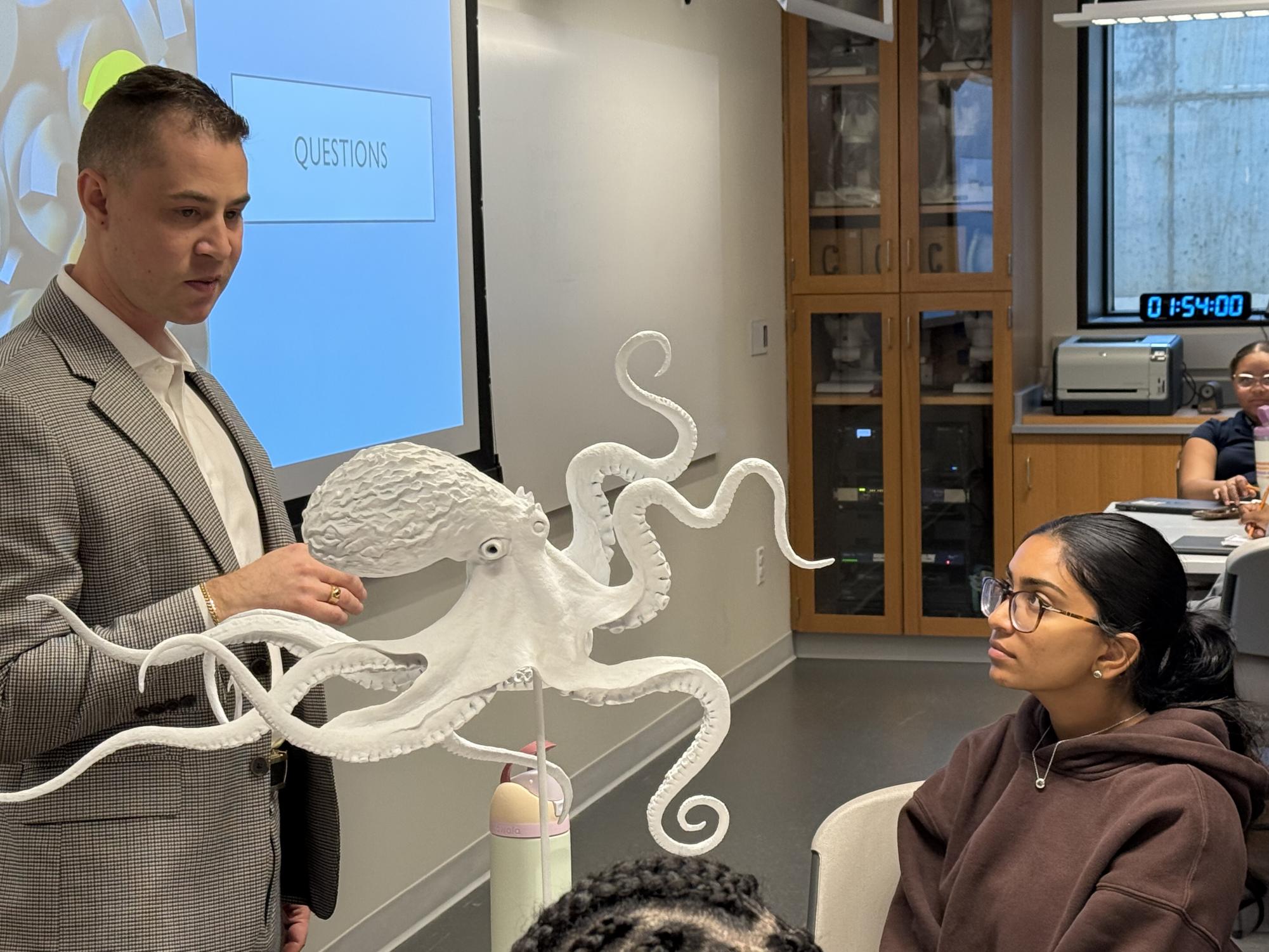
Collin Morét said that 3d printing is getting better and more efficient to use. He also said that he worked in different departments like anthropology. He is making a North Pacific Octopus. He makes 3D models and sometimes paints them. When asked what his least favorite 3D project is he said, “I don’t have one but insects and small creatures are hard because they’re really small so the scanner can’t scan them as well so they are not as accurate.” I found it very interesting that for the Dodo bird 3D model they used real feathers on top of the plastic.—Rafi F. Conroe
The best work I saw was the Dodo bird. They are working on the octopus and they are using 3D scanning and painting to make it look realistic. 3D scanning is cool because of all that it can do to replace taxidermy. —Raina Bellamy
Collin Morét talked to us about using newer technology such as 3D printing and digitizing artifacts. He showed us examples of how this technology will create a more advanced way to make artifacts in a way that can be used in exhibits, education, and in research. His presentation taught us more about what happens behind the scenes of the exhibits at the Peabody Museum. He showed us how using modern, innovative technology can improve education and make better models, especially of artifacts when they can’t share the original physical object, or artifacts that they can’t get their hands on.—Nayala Conroe
My honest perspective on Collin Morét is that he’s a very creative and innovative person and I find that he has an optimistic personality. Being expressive and confident in all answers with lots of respect towards students. Collin believes that there is a grand future with technology in his field of work. For example, the change in the museum to using 3D printing, Multimedia content and many more digital processes. —Marlin Rodriguez
My impression of Collin Morét was that 3D printing as a job would be very interesting. I personally want to learn how to 3D print because the technology is awesome. Listening to him talking, I realized that if you try hard enough you can do what you love to make money. —Haven Pickett
The birds have real feathers. The animals were fake, but we visited to check on the OCTOPUS!
It was both cool and kinda gooey! It can chew up purple stuff. WHO IS THIS?
After we (The East Rock Record reporters) interviewed Collin Morét, we asked questions. I thought it was interesting how long it takes to produce 3D models. I thought it only took a couple of minutes to create an entire 3D model, but I have learned that it takes hours to make only part of the model and it takes work to assemble all of the pieces. —Serelle Barsalou
They use 3d printers to model and replicate extinct animals. They are working on cool dinos. Me like 3D printing. Birds R Cool.—Ouji Dubee
Collin Morét, an expert on 3D printing, which is used in the Peabody Museum to replace some versions of taxidermy, talked to members of the East Rock Record. It was very interesting to hear about his work. I appreciate that 3D printing is being used to make models of animals instead of using taxidermy. Having been to the museum before, I realize how much 3D printing has helped with the exhibits of the Peabody Museum.— Alya Mikkelson
I thought that was really exciting to get answers from someone who knows what they are talking about, and they talked about dinosaurs. I learned that the biggest 3D print they made was the Dodo bird. It was really INTERESTING! —Weiyu Zhong
The biggest model that Collin Morét made was the Dodo bird. It is so amazing how they can use technology to make something look like an animal that isn’t even still around anymore.
This was definitely a major learning experience for me, and I am very grateful for being able to listen to Mr. Morét.— Kendall Walker-Gurley